
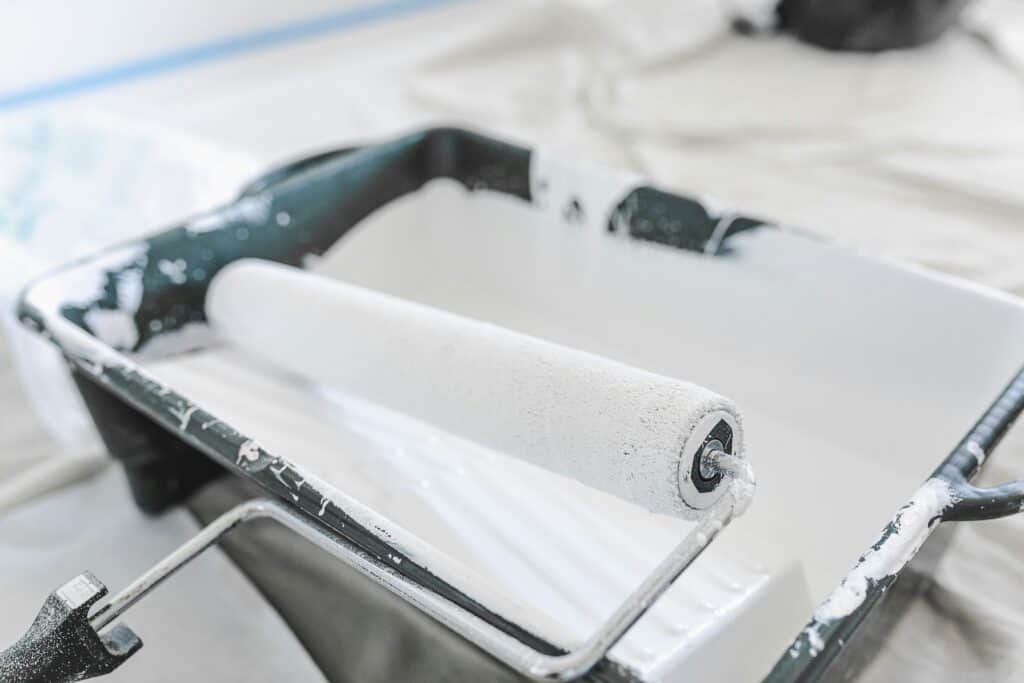
Basement walls face challenges that most interior walls never encounter. Concrete and masonry surfaces are naturally porous, allowing moisture vapor to move through them over time. In many homes, seasonal humidity, minor water intrusion, condensation, and even hydrostatic pressure can create conditions that lead to peeling paint, staining, mold growth, and premature coating failure.
That’s why selecting the right primer is one of the most important steps in any basement painting project. A quality basement primer helps seal porous surfaces, improves paint adhesion, blocks stains, and creates a stronger barrier against moisture-related issues. Whether you’re finishing a basement, refreshing painted concrete walls, or preparing a previously damp space for a new coat of paint, using the correct primer can dramatically improve the longevity and appearance of the finished project.
The best primer for your basement depends on the condition of the walls, the level of moisture present, and whether you’re working with bare concrete, masonry, previously painted surfaces, or areas that have experienced mold or mildew. Below are our top recommendations for basement wall primers based on performance, durability, moisture resistance, and ease of application.
Top Primer Recommendations for Basement Walls
Best overall for unfinished basement masonry with minor dampness or efflorescence: DRYLOK Wet Wall Bonding Primer. It is explicitly built for dry, wet, bare, or pre-coated masonry before painting or waterproofing; it offers stain blocking plus efflorescence and mold resistance; and it is safe on green concrete up to pH 13.0. That is unusually basement-specific for a true primer.
Best for dry, bare concrete or cinder block: BEHR Premium Concrete & Masonry Bonding Primer. BEHR says it promotes strong adhesion, works on uncoated or previously coated concrete and masonry, and provides resistance to water, alkali, and efflorescence. BEHR’s own prep guidance also recommends it for areas with persistent moisture exposure or surfaces previously treated for efflorescence or laitance.
Best for peeling or chalky old painted walls: Zinsser Peel Stop Triple Thick. Its data sheet is very specific: it is a binding primer designed to penetrate and stop previous coatings from peeling, fill and seal cracked or weathered surfaces, and create a smoother finish for repainting.
Best all-purpose primer for finished basement drywall or mixed surfaces: Zinsser Bulls Eye 1-2-3 Water-Based Primer. It sticks to concrete, masonry, drywall, and glossy surfaces, resists mold and mildew, tolerates pH up to 12.5, and topcoats in about an hour. It is stronger than a basic drywall-only primer and fits finished basements better when conditions are dry.
Best when “primer” is the wrong category and you really need waterproofing: Zinsser WaterTite, DRYLOK Extreme, KILZ Basement & Masonry Waterproofer, or LOXON Water Blocking Primer/Finish, depending on system preference and the severity of moisture. These are not interchangeable with a standard primer, but they are the right conversation once seepage, hydrostatic pressure, or below-grade moisture is the real issue.
Best Primer for Basement Walls
If you are painting basement walls, the best primer is not always the one with the highest reviews or the cheapest gallon price. Basements are different from standard interior rooms because the walls are often below grade, porous, more alkaline, and more exposed to moisture vapor, efflorescence, and seasonal dampness. EPA’s guidance is blunt on this point: mold control starts with moisture control, and wet areas need to be dried and the water source fixed. That means the right basement wall primer depends first on whether your wall is dry concrete, slightly damp masonry, old painted and peeling, or finished drywall. If you are looking for the best basement wall paint, look to our guide.
The short answer is this. For dry, bare concrete or cinder block, use a true concrete or masonry bonding primer. For slightly damp basement walls or surfaces with recurring efflorescence, use a primer designed for wet masonry, such as DRYLOK Wet Wall Bonding Primer. For old painted walls with peeling paint, use a binding primer like Zinsser Peel Stop Triple Thick. For a finished basement with drywall that is actually dry and climate-controlled, an all-purpose acrylic primer such as Zinsser Bulls Eye 1-2-3 is usually the best fit. And if water is actively coming through the wall, stop looking for ordinary primer and move to a waterproofing system instead.
Why do basement walls need a different primer?
Concrete and concrete block walls are more absorbent than ordinary drywall, and that changes everything about paint adhesion. KILZ notes that masonry and concrete absorb too much paint without a sealing coat, which can leave you with uneven sheen, poor adhesion, and more coats than expected. The same KILZ guidance also points out that fresh concrete has a high pH, which can cause adhesion problems and color fade. Sherwin-Williams and Zinsser make similar points in their technical sheets, with products that are specifically designed to tolerate high-pH masonry and seal porous surfaces before topcoating.
Basement walls also fail for a different reason than typical interior walls: water pressure and water migration. If you have minor dampness, white powdery residue, musty odors, or bubbling and peeling paint, that is often a clue that moisture is moving through the masonry. EPA’s moisture guidance lists seepage, wicking, efflorescence, peeling paint, and mold growth as warning signs. At that point, even an excellent primer will only succeed if the wall is properly cleaned, repaired, and dry enough for the chosen system.
Best Primer for Basement Walls Overall
For most unfinished basement walls made of masonry, cinder block, or poured concrete, my top pick is DRYLOK Wet Wall Bonding Primer. The reason is simple: it is one of the few mainstream primers that is explicitly engineered for this exact use case. DRYLOK says it can be applied to dry, wet, bare, or pre-coated masonry and concrete before painting or waterproofing. It is also made to resist efflorescence and mold and mildew, and it can be used on green concrete up to pH 13.0. That combination makes it a better basement-specific choice than a generic wall primer.
This is the primer I would choose when the wall is not actively leaking, but it never feels fully perfect, or when you have a wet-looking area that keeps returning after rain. DRYLOK’s own application guidance says it is meant for wet masonry surfaces, though not for active leaks, and recommends patching holes and cracks and neutralizing efflorescence first. That makes it ideal for the common basement scenario of minor dampness rather than full-blown water intrusion.
Best Primer for Dry Concrete Basement Walls
If your basement walls are dry, sound, and already well-prepped, I would lean toward BEHR Premium Concrete & Masonry Bonding Primer. BEHR describes it as a high-performance water-based primer for concrete and masonry that promotes a uniform topcoat and strong adhesion on uncoated or previously coated surfaces. Elsewhere in BEHR’s technical materials, the brand says the product resists water, alkali, and efflorescence and is appropriate when a surface has persistent moisture exposure or has been previously treated for efflorescence or laitance.
That makes BEHR especially attractive for a basement wall that is structurally okay, dry enough to take a coating, and likely to get a decorative acrylic or latex topcoat afterward. In plain terms, it is a strong “best results” pick for dry concrete basement walls, dry cinder block, and paint-ready masonry surfaces where you want good adhesion and a smoother finish without jumping straight into a dedicated waterproofing system.
Best Primer for Peeling Paint on Basement Walls
If your old basement coating is cracking, flaking, or lifting, primer choice changes again. In that situation, a bonding primer that deals with peeling paint and weak edges is more important than a simple masonry sealer. Zinsser Peel Stop Triple Thick is the cleanest fit here because Rust-Oleum describes it as a water-based acrylic binding primer designed to penetrate and stop previous coatings from peeling, while filling and sealing cracked and weathered surfaces to create a smoother paintable base.
That does not mean you can skip prep. The data sheet still says the surface needs to be clean, sound, and free of contaminants; loose and peeling paint still has to be scraped away; and if you are disturbing old paint, lead safety matters. EPA warns that renovation, repair, or painting work in pre-1978 homes can create dangerous lead dust and recommends lead-safe practices or certified help.
Best primer for finished basement drywall
A finished basement is a different problem from an unfinished masonry basement. If you are priming drywall in a basement that is already dry, insulated, and climate-controlled, you do not need the same product that you would use on a raw concrete block wall. In that case, Zinsser Bulls Eye 1-2-3 Water-Based Primer is the strongest all-around choice because it is approved for drywall, concrete, stucco, and masonry; it resists mold and mildew; it tolerates high pH up to 12.5; and it topcoats in about an hour.
A close alternative is KILZ 2 All-Purpose Primer, which KILZ says can be used on drywall, plaster, masonry, and brick and offers mildew resistance with a mild odor. The caution is that KILZ’s technical data specifically says masonry should be clean, dry, aged, and cured at least 30 days. So it is a good product for a finished basement or mixed-surface room, but not the primer I would choose for a damp below-grade wall.
When you Need a Waterproofer Instead of a Primer
A lot of homeowners search for “best primer for basement walls” when the real issue is water infiltration. If your walls show frequent seepage, the surface feels truly wet, or you are dealing with hydrostatic pressure, a regular primer may be the wrong category. Zinsser WaterTite is designed as a two-coat waterproofing system where the first coat primes and seals and the second coat completes the barrier, with resistance up to 34 psi. DRYLOK Extreme is rated up to 15 psi, and LOXON Water Blocking Primer/Finish is marketed as resistant up to 12 psi on interior masonry.
KILZ Basement & Masonry Waterproofer belongs in this same conversation. KILZ says it is designed for porous concrete and masonry on above- and below-grade basement walls and foundation walls, but its technical sheet also says it is not for active water leaks and should not be used over ordinary latex or oil paint. That is a good reminder that even waterproofing paint has limits. If the wall is actively leaking, fix the drainage and crack issues first.
How to prep basement walls before priming?
Good surface prep is what separates a paint job that lasts from one that starts bubbling by the next humid summer. Start by removing dust, grease, loose paint, chalk, mold residue, and efflorescence. DRYLOK and Zinsser both say efflorescence has to be removed because it interferes with bonding. DRYLOK also recommends patching holes and cracks before priming. KILZ says below-grade cracks and holes should be patched with fast-setting hydraulic cement before applying basement masonry waterproofer.
Next, check whether the wall is absorbent enough to take a coating. BEHR’s prep guidance says the surface is ready when water is quickly absorbed and the profile feels like about 150-grit sandpaper. DRYLOK says the surface profile should resemble medium-grit sandpaper and that water droplets should soak in “like a sponge.” If the wall is very smooth, an etch or aggressive cleaning step may be necessary to open the pores.
Finally, if the home may have old lead-based paint, slow down. EPA says any renovation, repair, or painting work that disturbs old paint in pre-1978 homes can create dangerous lead dust and recommends lead-safe practices or certified help. That matters just as much in a basement as it does anywhere else in the house.
Final Primer Thoughts
The best primer for basement walls overall is DRYLOK Wet Wall Bonding Primer if you are dealing with unfinished masonry, minor dampness, recurring efflorescence, or a wall that never quite feels perfect but is not actively leaking. If the wall is dry and paint-ready, BEHR Premium Concrete & Masonry Bonding Primer is the better pick for strong adhesion on concrete and cinder block. If the old paint is peeling, use Zinsser Peel Stop Triple Thick. For finished, dry basement drywall or mixed surfaces, use Zinsser Bulls Eye 1-2-3, with KILZ 2 as a solid backup option. And if the real problem is seepage or hydrostatic pressure, stop shopping for regular primer and move to a waterproofing system instead.
Great content! Keep up the good work!